

Introduction
An outdoor fireplace is more than a source of warmth. It can serve as a functional heating device, a visual focal point, and, depending on its design, a space for cooking and social interaction. Therefore, choosing the right fireplace should not be based solely on appearance or price. A more appropriate approach is to evaluate the product systematically according to its material, shape, size, weight, intended use, transportation requirements, maintenance needs, and safety performance.
Historically, outdoor fireplaces such as chimineas were developed as practical heating and cooking appliances. Traditional chimineas were commonly made from clay or terracotta and featured a rounded fire chamber with a chimney that directed smoke upward. Historical accounts trace their development through Spain and Mexico, where they were used for both heating and cooking.
Modern outdoor fireplaces have evolved considerably. In addition to traditional ceramic designs, contemporary products are available in steel, cast iron, stainless steel, and other materials. Their functions have also expanded from simple heating to include outdoor cooking, entertainment, garden decoration, and integration with modern outdoor living spaces. Consequently, selecting an outdoor fireplace today requires balancing performance, durability, appearance, practicality, and safety.
The following factors provide a systematic framework for making an appropriate choice.
Material
Material is one of the most important factors when selecting an outdoor fireplace because it directly influences durability, heat resistance, weight, corrosion resistance, maintenance requirements, and overall service life.
Clay and Ceramic
Clay or ceramic is the traditional material used for chimineas. Its major advantage is its traditional appearance and relatively good heat-retention characteristics. However, ceramic products are relatively fragile and can be susceptible to cracking, particularly when exposed to sudden temperature changes or freezing conditions. Therefore, ceramic fireplaces are generally more suitable for users who prioritize traditional aesthetics and occasional use rather than maximum durability or frequent relocation.
Cast Iron
Cast iron provides excellent structural strength and good heat retention. It is therefore suitable for users looking for a heavy, traditional fireplace with a strong sense of permanence. However, its high density makes cast-iron fireplaces considerably heavier than sheet-metal alternatives. Corrosion can also become an issue if the surface is not adequately protected and maintained.
Steel
Steel offers a useful balance between strength, weight, design flexibility, and cost. It is particularly suitable for contemporary outdoor fireplaces because manufacturers can produce a wide range of shapes and structures through cutting, bending, welding, and other forming processes. For outdoor applications, however, the choice of steel and surface treatment is important. Factors such as steel thickness, coating quality, drainage design, and exposure to rain and humidity can significantly influence long-term durability.
Stainless Steel
Stainless steel provides superior corrosion resistance compared with conventional carbon steel and is therefore suitable for humid or coastal environments. However, its higher material cost may make it less economical for large-volume or price-sensitive applications.
Material Selection Principle: There is therefore no single material that is universally “best.” The appropriate material depends on the intended application: Traditional appearance → Ceramic / Clay. High heat retention and heavy-duty construction → Cast Iron. Balance of durability, weight and cost → Steel. High corrosion resistance → Stainless Steel.
Shape
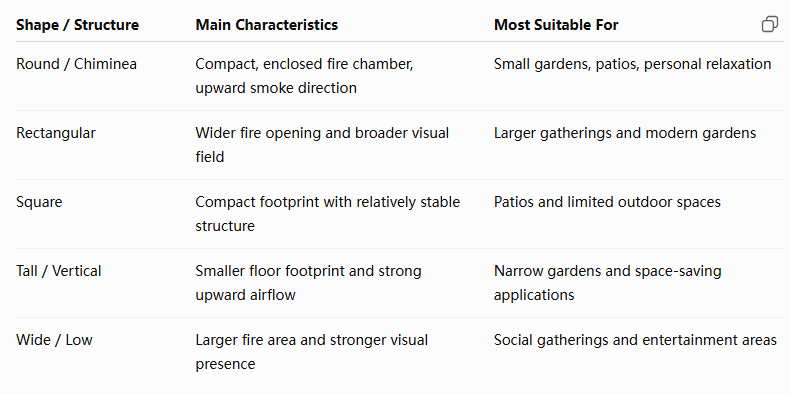
The shape of an outdoor fireplace is not merely an aesthetic decision. It influences heat distribution, airflow, smoke direction, fire visibility, cooking accessibility, stability, and space utilization.
Traditional chimineas generally use a rounded or bulbous fire chamber combined with a narrow chimney. This configuration helps contain the fire and directs smoke upward, while allowing radiant heat to reach the surrounding area.
Modern outdoor fireplaces can generally be divided into several structural categories.
Size, Weight and Capacity: Matching the Fireplace to the User
Size is one of the easiest factors to overlook. A fireplace that is too small may not provide sufficient heat or usable fire space, while an unnecessarily large model can consume more fuel, occupy excessive space, and become difficult to transport.
The appropriate size should therefore be determined by three variables: Available outdoor space / Expected number of users / Primary purpose of the fireplace
For example, a fireplace intended for one or two people in a small patio does not need the same fire chamber capacity as a model intended for a family gathering.
The following table can be used as a general product-selection reference. Exact weight should always be based on the actual product because material, wall thickness, structural reinforcement, and accessories can substantially affect the final weight.
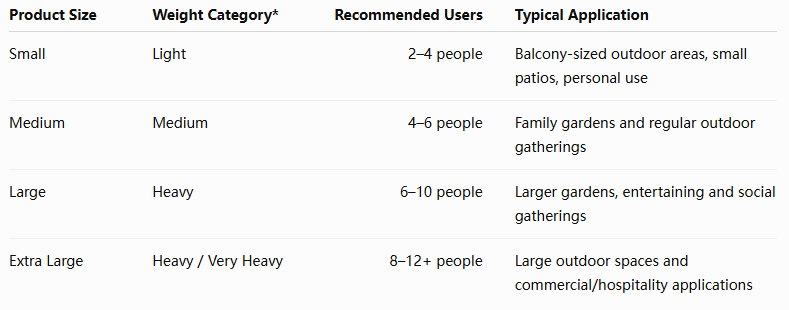
Larger does not automatically mean better. A larger fire chamber generally provides greater fire capacity and can support more users, but it may also require more fuel and more surrounding clearance. In addition, the increased weight can make transportation, installation, and repositioning more difficult.
Therefore, size selection should be based on the relationship between heating area, user capacity, available space, and mobility, rather than dimensions alone.
Packaging and Transportation
For modern outdoor fireplaces, packaging and transportation should be considered as part of the product-selection process, especially when purchasing online or transporting the product over long distances.
Outdoor fireplaces are often relatively large compared with their packaged dimensions. A product may have a moderate weight but still require considerable transportation volume. Therefore, both gross weight and volumetric efficiency should be considered.
A detachable or knock-down structure can provide several advantages:
- Reduced carton dimensions
- Lower transportation volume
- More efficient container utilization
- Easier warehouse storage
- Lower shipping costs
- Easier delivery to residential customers
- Reduced risk of damage during transportation
However, a modular structure should not compromise the stability of the assembled fireplace. Connection points, fasteners, supporting legs, chimney sections, and other detachable components should be sufficiently robust for repeated assembly and outdoor use.
This is particularly important for e-commerce chimenea, where packaging efficiency directly affects the total delivered cost. Therefore, when comparing two fireplaces with similar functions, a model with a well-designed knock down structure may have a practical advantage even if its initial product price is slightly higher.
Maintenance
Outdoor fireplaces are continuously exposed to heat, moisture, rain, dust, ash, and temperature fluctuations. Consequently, maintenance is not simply an aesthetic issue; it directly influences product life and safe operation. The basic maintenance process includes four areas.
Ash Removal
Ash should be removed regularly after the fire has completely cooled. Excessive ash can restrict airflow and make combustion less efficient.
Surface Cleaning
Soot, dust and other residues should be removed periodically. Mild cleaning methods are generally preferable to highly abrasive products that may damage protective surface treatments.
Rust and Structural Inspection
For metal fireplaces, users should periodically inspect: Rust / Cracks / Welded joints / Fasteners / Handles / Legs and supporting structures / Chimney sections / Spark screens. Manufacturer care instructions commonly recommend inspecting the unit regularly and only carrying out cleaning or maintenance after the fireplace has completely cooled.
Weather Protection
If the fireplace remains outdoors for extended periods, a suitable weather-resistant cover can reduce exposure to rain and humidity. Where possible, the fireplace should also be positioned so that water does not accumulate inside the fire chamber. For metal products, appropriate high-temperature protective coatings can also help reduce corrosion and surface deterioration.
Good maintenance does not change the basic quality of a fireplace, but it can significantly extend the useful life of the product.
Safety: The Most Important Selection Criterion
Among all selection criteria, safety should be considered non-negotiable. An outdoor fireplace is a controlled fire appliance, but it still produces high temperatures, flames, smoke and embers. Therefore, users should evaluate both the product design and the intended installation environment before purchase.
Location
A fireplace should be installed on a stable, non-combustible and level surface. It should not be positioned directly on dry grass, wooden decking, or other combustible surfaces. Local regulations should also be checked because restrictions on recreational outdoor fires vary by location.
Clearance
Adequate clearance should be maintained between the fireplace and combustible structures, vegetation, furniture, fences and overhead materials.
Fuel
For wood-burning fireplaces, users should burn dry, seasoned wood rather than wet or green wood. The U.S. Environmental Protection Agency recommends wood with a moisture content of approximately 20% or less, because wet wood generates more smoke and burns less efficiently. Users should also avoid burning:
- Plastic
- Household garbage
- Pressure-treated wood
- Composite materials
- Painted or chemically treated wood
These materials can release harmful substances and may also damage the appliance.
Fire Management
A fireplace should not be overloaded with fuel. Starting with a smaller fire and gradually increasing the fire size allows users to better understand the heating behavior of the appliance. A spark screen or other appropriate spark-control device can also reduce the risk of burning embers escaping from the fire chamber. Finally, children and pets should be kept away from the fireplace during and shortly after operation because the exterior surfaces may remain extremely hot even after the visible fire has gone out.
Conclusion: Choosing the Right Fireplace Is a Multi-Factor Decision
Choosing an outdoor fireplace should not be reduced to comparing price, appearance, or size alone. A more rational selection process considers the product as an integrated system.
The decision can be summarized as follows: Material determines durability and maintenance requirements. Shape influences heat distribution, smoke direction and usability. Size and weight determine capacity, mobility and suitability for the available space. Packaging and transportation affect logistics efficiency and total cost. Application determines whether the product should focus on heating, cooking, or both. Maintenance influences long-term performance and service life. Safety determines whether the fireplace can be used responsibly in its intended environment.
Therefore, the ideal fireplace is not necessarily the largest, heaviest, or most expensive model. Instead, it is the model whose material, dimensions, structure and functions are appropriately matched to the user’s environment and intended application.
A practical decision-making sequence can be expressed as: Define the intended use → Assess the available space → Select the appropriate size → Compare materials → Evaluate weight and transportation → Check maintenance requirements → Confirm safety and local regulations.
By following this framework, consumers can move from simply choosing a visually attractive fireplace to making a more informed, functional, and sustainable purchasing decision.