


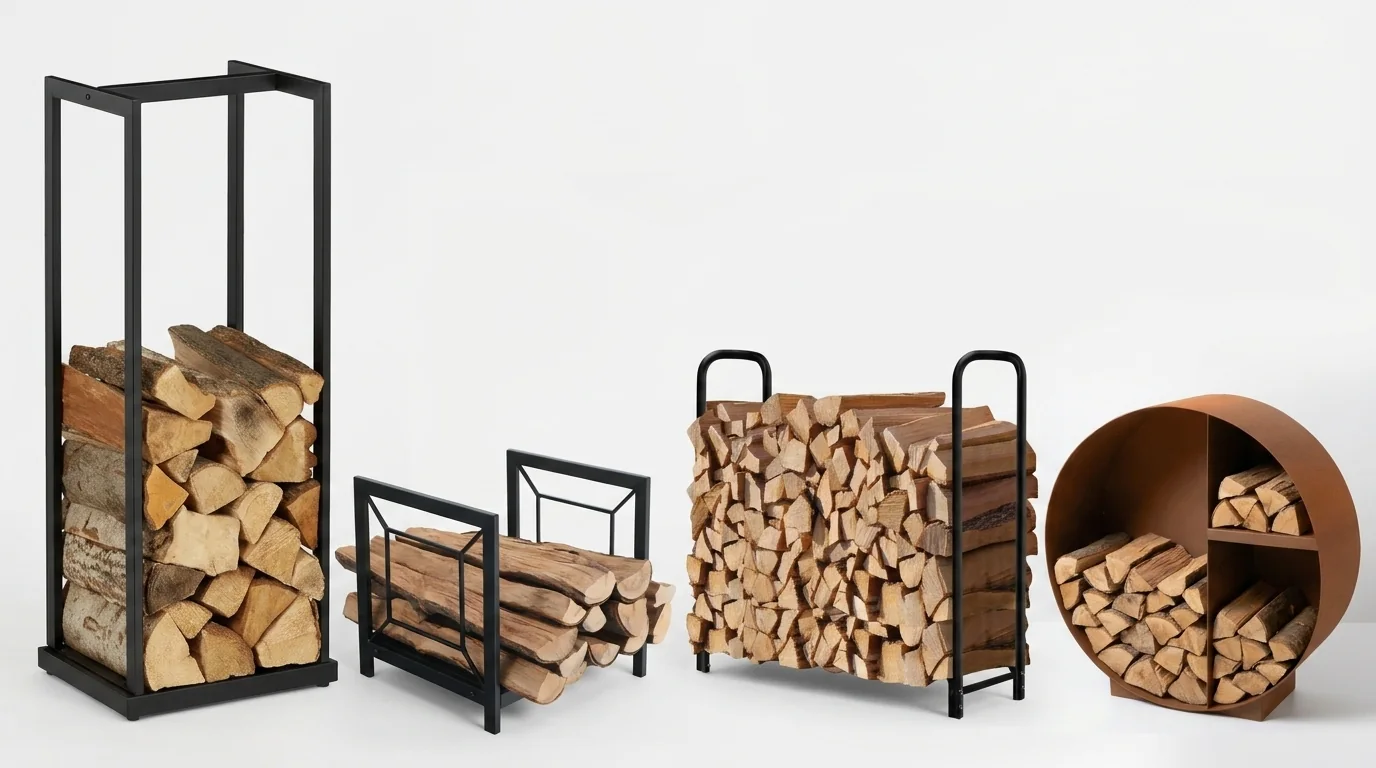
How to Choose Different Types of Firewood Racks
Compare rack types, load capacity, climate suitability, placement, KD packaging, maintenance, and safety.
A firewood rack keeps logs off damp ground, improves airflow around stored wood, organizes the storage area, and supports safer stacking. The best rack depends on the quantity of wood, available space, local climate, required load capacity, and whether logistics favor a knock-down structure.
Start with load capacity and placement. For compact spaces, use a narrow or mini rack. For bulk seasonal storage, choose a long reinforced rack. In rainy, humid, or coastal environments, prioritize weather-resistant materials and finishes. Corten steel is an option to discuss for demanding outdoor exposure.
1. Why Use a Firewood Rack?
- Keeps firewood off the ground. This reduces direct contact with wet soil, rain-soaked floors, and dew.
- Improves air circulation. An open frame allows airflow around the stack and helps wood stay dry.
- Supports stable stacking. A defined rack reduces loose logs rolling or collapsing into walkways.
- Keeps the area organized. Logs stay in one dedicated storage zone instead of forming irregular piles.
2. Compare Firewood Rack Types
| Rack Type | Best For | Main Advantages |
|---|---|---|
| Tube-style rack | Backyards, patios, beside fireplaces | Simple stable structure, good load capacity, commonly suitable for KD packing |
| Corten steel rack | High-end yards, landscape projects, hospitality spaces | Natural weathering appearance and strong outdoor decorative value |
| Powder-coated carbon steel rack | Household outdoor use, balconies, garages | Cost-effective manufacturing, multiple color options, coated surface protection |
| Compact / mini rack | Small patios, balcony corners, temporary indoor-side storage | Small footprint, lighter weight, easier relocation |
| Long / heavy-duty rack | Large yards, farms, campsites, commercial sites | Large seasonal storage capacity and reinforced structure |
3. Check Load-Bearing Capacity
Estimate both the quantity and length of the firewood to be stored, then choose a rack with a rated load above the expected wood weight. Heavy logs can bend weak frames, so pay attention to structural reinforcement, material thickness, welded joints, and connection hardware.
Do not overload the rack beyond its rated capacity. Excessive weight can cause frame bending, weld cracking, deformation, or collapse.
4. Match the Rack to the Placement Area
Measure the available space before selecting a model. Consider whether the rack will be placed in a backyard, on a patio, beside a fire pit, in a garage, or under a shed.
Compact areas favor narrow racks. Large open yards can use longer models for greater storage. Leave room around the stack for airflow rather than packing firewood tightly against walls or other objects.
5. Consider the Local Climate
Rain, humidity, salt air, dew, and snow all affect rack selection. In rainy, humid, or coastal areas, corrosion resistance becomes more important. For open-air exposure in those conditions, consider Corten steel and confirm the finish for your intended environment.
In heavy-snow regions, consider the combined load of the stored firewood and accumulated snow when evaluating structural capacity.
6. KD Structure vs. Fully Assembled
Firewood racks can be supplied as knock-down (KD) structures or as fully assembled products. Five-layer cardboard cartons provide protection in transit; confirm the packaging specification for your order.
| Structure | Advantage | Commercial Consideration |
|---|---|---|
| KD / knock-down | Lower packed volume | Better freight efficiency, carton packing, sea freight, and container loading |
| Fully assembled | Ready to use after delivery | No end-user assembly, but higher shipping volume |
For market-oriented products, KD structures often provide a better balance of transport cost and storage efficiency, provided the assembled rack remains stable and easy to build.
7. Maintenance and Safety
- For powder-coated carbon steel, inspect scratches or coating damage and repair exposed metal as appropriate.
- Remove dirt, dew, and accumulated snow to reduce prolonged moisture exposure.
- Inspect bolts, welded joints, and connections regularly and tighten loose hardware.
- Place the rack on flat, solid ground and keep it a safe distance from open flames.
- Keep children and pets away from unstable stacks, and do not climb or stand on the rack.
- Stop using the rack if severe rust, cracks, or structural damage is found.
Sourcing firewood racks for retail or distribution?
Share the target rack type, material, dimensions, load requirement, packaging format, and expected order quantity.